How to play WordHunt
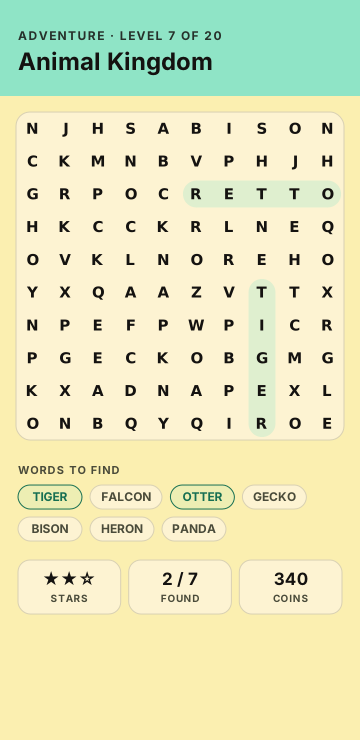
To play WordHunt, drag from the first letter of a hidden word to its last letter. Words run in up to eight directions depending on difficulty. Finding every word on the list completes the level and awards up to three stars, based on your combo multiplier and how few hints you used.
What are the rules of WordHunt?
Six steps cover everything. Nothing below is mode-specific — the same rules apply in Adventure, Daily Hunt, Quick Play, Mystery, Create and Friends.
Read the word list first
The list sits under the grid. Skim it before you look at a single letter — knowing you are hunting for OTTER and HERON turns a wall of letters into two targets. Players who start scanning before reading the list consistently take longer.
Drag from the first letter to the last
Press the first letter, drag, and lift on the last. The selection snaps to whichever of the eight directions your finger is closest to, so you do not need to trace precisely. If you lift on the wrong cell, nothing is lost — a wrong selection simply clears.
Work one direction at a time
Scanning a grid in every direction at once is how people stall. Sweep the rows left to right, then the columns, then the diagonals. On Easy that is all you need, because words only run across and down.
Chain finds to build the combo
Finding words in quick succession raises a combo multiplier, and the multiplier is what separates a one-star finish from three. When you spot two words at once, take both immediately rather than pausing.
Spend a hint before you stall
Hints cost coins, and coins come from playing. A direction hint on the one word you cannot see is usually cheaper, in stars, than losing the combo entirely. There are 5 hint types and no way to buy them with money.
Watch for bonus words
Some grids contain valid words that are not on the list. They are worth extra and cost nothing to take. They never block completion, so ignore them if you are racing the Expert clock.
Try it on today’s puzzle
200 levels, 6 modes and no account to create. Free on Android 7.0 and above.
- Free
- No sign-up
- Works offline

Which directions can words run in?
It depends on the difficulty. This is the single biggest jump in difficulty in the game, because each added direction multiplies the number of lines you have to check.
| Difficulty | Grid | Directions allowed | Words |
|---|---|---|---|
| Easy | 8×8 | Across and down only | 5–6 words |
| Medium | 10×10 | Adds diagonals and reversals | 7–9 words |
| Hard | 12×12 | All eight directions | 10–12 words |
| ExpertTimed | 14×14 | All eight directions | 12–15 words |
How is scoring calculated in WordHunt?
Three things drive your score: the words you find, the combo multiplier you hold while finding them, and any bonus words you pick up along the way. Stars are awarded on that total.
- Words found
- Every word on the list contributes. Longer words are worth more than short ones.
- Combo multiplier
- Finding words in quick succession raises a multiplier. Pausing lets it decay, so momentum is worth real points.
- Bonus words
- Valid words hidden in the grid but absent from the list. Optional, and worth extra.
- Hints used
- Each hint spent reduces the efficiency of a finish, which is what stops a three-star run.
- Time remaining
- On Expert puzzles only. The clock is the fourth difficulty preset’s defining constraint.
What does each hint do, and what does it cost?
WordHunt has 5 hints, all paid for with coins you earn by playing. There is no way to buy coins with money, so hints can never become a paywall.
First letter
Reveals the opening letter of a word you have not found.
Direction
Shows which way an unfound word runs on the grid.
Reveal word
Marks a whole word as found.
Shuffle
Rebuilds the board with the same words in new positions.
Add time
Extends the clock in timed Expert puzzles.
For techniques that reduce how often you need a hint at all, read 9 word search techniques that actually work.
Playing WordHunt: common questions
How do you select a word in WordHunt?
Do words run backwards in WordHunt?
What are bonus words?
How do you earn three stars on a level?
Can you run out of hints in WordHunt?
Start with an 8×8 grid
Easy puzzles use across and down only — a good place to learn the controls. Free on Google Play.
- Free
- No sign-up
- Works offline